What Keeps CISOs Awake? – It’s Not Just Hackers, It’s Compliance.
CISOs today are no longer just defenders of the network; they are strategic business leaders sitting at the crossroads of innovation, regulation, and risk.
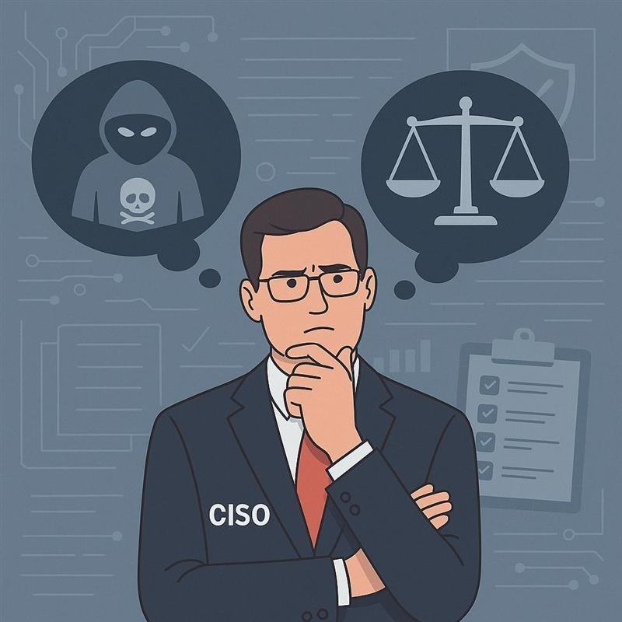
Every new technology, AI, cloud, IoT, 5G, quantum computing promises growth but also multiplies exposure. Boards want agility, regulators want assurance, and customers want trust.
The challenge? Balancing it all.
In 2025, the biggest cybersecurity risk isn’t just the next breach — it’s the widening gap between technological ambition and regulatory readiness.
For today’s CISO, challenges include:
- Translating cyber risk into business language the board understands.
- Proving compliance across dozens of overlapping frameworks.
- Protecting data across hybrid clouds and generative AI systems.
- Building trust at scale without slowing innovation.
And that’s what keeps CISOs awake at night.
CISOs focus not only on protecting against cyber threats but also on continuously ensuring security, compliance, and business continuity.
The Quiet Weight: The Leadership Tightrope CISOs Walk
Today’s CISOs are navigating a blended storm of innovation, oversight, and expectation.
They’re not just defending perimeters; they’re defending decisions in a world where every new tool, partner, or platform introduces new obligations.
1. Multiplying mandates, shrinking clarity
Global operations now span overlapping frameworks ISO, NIST, GDPR, DORA, DPDPA, SOC2, etc, each demanding evidence, audit trails, and accountability. While multiple frameworks introduce additional considerations, they help organizations strengthen controls and ensure thorough protection.
2. Boards want numbers, not narratives
Cyber Risk is now a boardroom material. Leadership expects metrics that translate into financial impact, not technical jargon. CISOs are under pressure to quantify what has historically been qualitative.
3. Innovation vs. assurance
AI deployments, SaaS expansion, and hybrid cloud adoption drive business agility, but every innovation introduces new blind spots. CISOs must balance the pace of transformation with the patience of compliance.
4. Limited resources, limitless scrutiny
Security and compliance teams are often small compared to the scale of expectations. Evidence collection, audit prep, and risk reporting remain heavily manual, leaving little time for proactive defense.
5. Fragmented visibility
Multiple dashboards, siloed systems, inconsistent logs - CISOs are often flying blind in a cockpit full of blinking lights. Integrating risk, compliance, and security data into one coherent view remains a major challenge.
6. The human variable
No control framework can replace an empowered and aware workforce. While mistakes can happen, when employees are informed, engaged, and proactive, compliance and security thrive. True resilience comes from making every team member a part of the organization’s security journey.
The Reality :
For CISOs, the challenge isn’t choosing between compliance and security, it’s making them coexist without slowing the business down.
They must turn complexity into clarity, risk into strategy, and compliance into a narrative the board trusts - all while keeping the organization one step ahead of emerging threats. True leadership lies in transforming challenges into opportunities for resilience, innovation, and long-term business success.”
Let’s back that with numbers:
- India detected over 369 million malware events between October 2023 and September 2024 that’s ~702 potential threats per minute on average. [ https://www.tripwire.com/state-of-security/rising-tide-understanding-surge-cyber-attacks-india ]
- The average cost of a data breach in India (2025) grew to ₹22 crore (≈ INR 220 million), a ~13 % year-on-year increase. [https://www.ndtv.com/india-news/india-data-breach-costs-reach-new-record-level-of-22-crores-report-9037094 ]
- In 2024, cyber fraud cases in India rose more than four-fold vs. the previous fiscal year leading to losses of ~$20 million (USD) in high-value cases. [ https://www.reuters.com/world/india/india-says-cyber-fraud-cases-jumped-over-four-fold-fy2024-caused-20-mln-losses-2025-03-11 ]
- In a “Cyber Security Maturity Survey (India)” report, ≈ 73 % of Indian organizations said they were unaware whether they’d ever been attacked. Also, 57 % lack basic cyber hygiene practices. [ https://www.dsci.in/resource/content/india-cyber-threat-report-2025 ]
- Only 8 % of Indian organizations are reported to be prepared to secure their AI-driven future (i.e. 92 % are not adequately prepared). [ https://ciso.economictimes.indiatimes.com/news/cybercrime-fraud/only-8-of-indian-organizations-prepared-for-ai-cyber-threats/122225027 ]
These metrics emphasize the continuous vigilance and resilience of security professionals.
Compliance and Security: Striking the Right Balance:
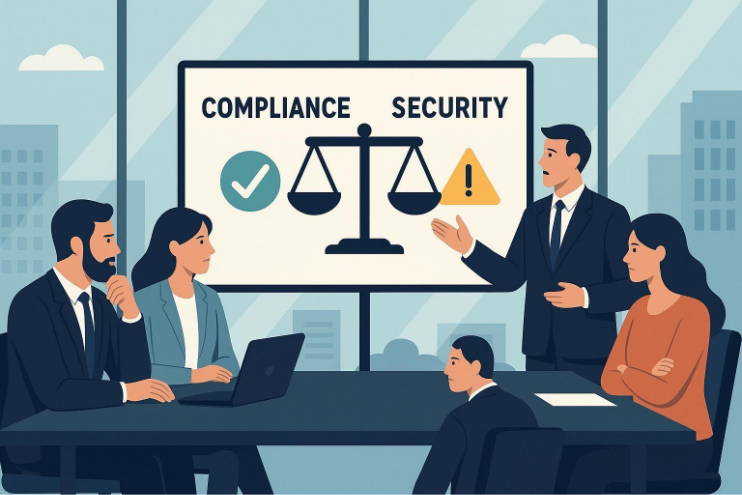
Here’s the reality every CISO knows but few say out loud:
✅ You can be compliant and still exposed.
⚠️ You can be secure and still fail an audit.
Compliance and security don’t always move in sync; one is about meeting obligations, the other about managing risk. True leadership lies in closing that gap.
Modern CISOs are shifting the conversation from “Are we compliant?” to “Are we resilient?”
Compliance frameworks, when done right, should enable agility, not restrict it. They should create visibility, not bureaucracy.
That alignment doesn’t happen by chance. It demands a blend of:
- Policy clarity translating regulations into practical, risk-based controls.
- Technology integration leveraging automation, AI, and analytics to reduce manual audit fatigue.
- Cultural maturity embedding accountability, so compliance becomes part of how business operates, not an afterthought.
The best CISOs don’t see compliance as Paperwork, they see it as strategic proof of trust.
When compliance drives resilience, the result isn’t just passing audits, it’s earning confidence from regulators, customers, and the board alike.
India’s compliance environment is no longer a checklist it’s a strategic governance challenge.
CISOs must act as interpreters between legal mandates, operational capabilities, and business priorities.
The best leaders in this space aren’t just meeting compliance they’re using it as a catalyst for modernization:
- Building audit-ready automation.
- Integrating data protection into design.
- Making compliance an operational advantage, not a bottleneck.
In India’s rapidly digitalizing economy, compliance is no longer optional it’s competitive currency.
A Real Challenge in Action:
The pressure isn’t theoretical it’s playing out in real time across India’s digital economy.
Between January and October 2023, India’s financial sector experienced an estimated 1.3 million attempted cyberattacks, with banks, NBFCs, and fintech firms among the primary targets — reflecting both the rapid pace of digital adoption and the high value of financial data.
At the same time, SEBI’s Cybersecurity and Cyber Resilience Framework (CSCRF) demanded that regulated entities provide comprehensive audit evidence, incident records, and proof of governance often within compressed timelines. For CISOs, this meant translating complex, evolving technical defenses into structured compliance reports that stand up to regulatory scrutiny.
Then came 2024, when a major crypto exchange breach resulted in losses exceeding USD 230 million. The incident didn’t just trigger financial damage; it reignited debates around digital asset regulation, board accountability, and real-time incident reporting. Regulators responded with calls for tighter controls, faster disclosures, and more visible governance.
The Human Backbone: Compliance Isn’t Just Technical
For all the frameworks, audits, and controls, one truth remains:
Compliance succeeds or fails at the human level.
Technology can detect anomalies, policies can define intent, but people determine whether those protections work.
- Many employees still see compliance as bureaucracy, not protection.
- Security teams struggle to make security hygiene feel natural, not forced.
- Managers under pressure for speed often trade off process for delivery.
That’s why great CISOs don’t lead with fear they lead with purpose.
“We don’t do this because regulators demand it.
We do it because trust is our most valuable currency and every action protects that trust.”
Building a resilient culture means shifting compliance from a checklist to a shared belief system where every individual understands that security is not an IT function, but a business habit.
The most mature organizations aren’t the ones with the longest policies they’re the ones where people instinctively do the right thing, even when no one’s watching.
Key Takeaway
What keeps CISOs awake isn’t just “Will we be breached?”
It’s the constant pressure to prove you can be trusted by regulators, by your board, by your customers.
Compliance isn’t a burden. It’s the backbone of credibility.
So, as we mark Cybersecurity Awareness Month:
- Focus not only on prevention but proof.
- Translate mandates into resilient behaviors, not checklists.
- Automate evidence collection and reporting.
- Build a narrative: “This isn’t red tape it’s how we earn trust.”
And if anything, truly keeps a CISO awake, it’s not the hackers it’s the audit clock.
Reference Links:
1. https://www.brightdefense.com/resources/cybersecurity-compliance-statistics/ (Bright Defense)
2. https://www.brightdefense.com/resources/cybersecurity-statistics/ (Bright Defense)
3. https://www.dlapiperdataprotection.com/?c=IN&t=law (DLA Piper Data Protection)
4. https://www.pib.gov.in/PressReleasePage.aspx?PRID=2148944 (Press Information Bureau)
5. https://www.medianama.com/2025/07/223-cert-in-cybersecurity-audit-rules-india/ (MEDIANAMA)
6. https://resourcehub.bakermckenzie.com/en/resources/global-data-and-cyber-handbook/asia-pacific/india/topics/regulators-enforcement-priorities-and-penalties (Baker McKenzie Resource Hub)
7. https://www.dpo-india.com/Blogs/data-breach-response-india/ (DPO INDIA)

Advisory & Compliance Services
Audit & Assessment Services
Managed Security Services
Governance & Compliance Framework Development
Cyber Key Performance IndicatorsCISO Advisory
Advisory and Compliance ServicesStandard & Regulatory AdvisoryBusiness Continuity & Disaster Recovery PlanningIncident Response ReadinessData Privacy
Audit and Assessment Services
Cloud Security Assessment
Cyber Maturity Assessment
Privacy Impact Assessment
Red Teaming Service
VAPT
Managed Security Services
SOC as a Service
Third Party Risk Management
Vulnerability Management Services